
Martial Arts Conditioning: The Tactical Path to Formidable Fitness

What if your fitness was measured by your ability to move under duress rather than the weight on a stationary barbell? Most traditional gym routines build muscle for the mirror, leaving you feeling physically vulnerable and bored with repetitive cycles that don't translate to the real world. True martial arts conditioning isn't about chasing vanity metrics. It is about forging a combat chassis designed to execute instinctual movement and maintain structural integrity during high-stakes encounters. You need a body that responds with precision when the environment turns hostile.
Move. React. Prevail. It's natural to feel frustrated by workouts that lack purpose or to fear that high-intensity training will lead to injury. You want functional strength and high-speed reflexes without the burnout. This article will teach you to master the science of combat-ready fitness so you can build a body that's as resilient as it is formidable. We'll break down the tactical methodology for developing explosive power, using AI-driven movement analysis to optimize your results, and preparing your central nervous system to handle real-world stress with disciplined efficiency.
Key Takeaways
Understand why traditional steady-state cardio fails in high-pressure scenarios and how to pivot toward a system that prioritizes metabolic efficiency.
Learn to build a "combat chassis" using a martial arts conditioning framework that focuses on generating explosive power from the ground up.
Discover why you don't need to "get in shape" before starting training, as tactical readiness is forged directly through the execution of Krav Maga techniques.
Identify the essential, low-equipment tools like kettlebells and sandbags that maximize real-world utility while developing functional endurance.
Explore how professional instruction at Performance Krav Maga in Egg Harbor City integrates these elite conditioning principles into every lesson for maximum efficiency.
Table of Contents
Beyond the Treadmill: What Real Martial Arts Conditioning Requires
True martial arts conditioning exists at the precise intersection of explosive power and metabolic efficiency. It isn't found on the rhythmic hum of a treadmill or the steady pace of a morning jog. While those activities build baseline health, they fail to prepare the human body for the chaotic reality of a 30-second altercation. Real-world violence is fast, jagged, and physically exhausting in a way that linear cardio cannot replicate. You need to transition from a state of physical vulnerability to one of formidable competence by subjecting yourself to structured, tactical stress.
This approach embodies the "Quiet Professional" vibe. We don't train for the mirror; we train for the moment. This brand of fitness is functional and lean, stripped of the flashy marketing fluff that characterizes many commercial gym routines. It's about readiness. It's about the psychological boost that comes from knowing your body is a reliable tool, capable of removing obstacles and maintaining continuity under pressure. When you move with purpose, you project a sense of disciplined authority that often deters conflict before it begins.
The Anatomy of a Tactical Encounter
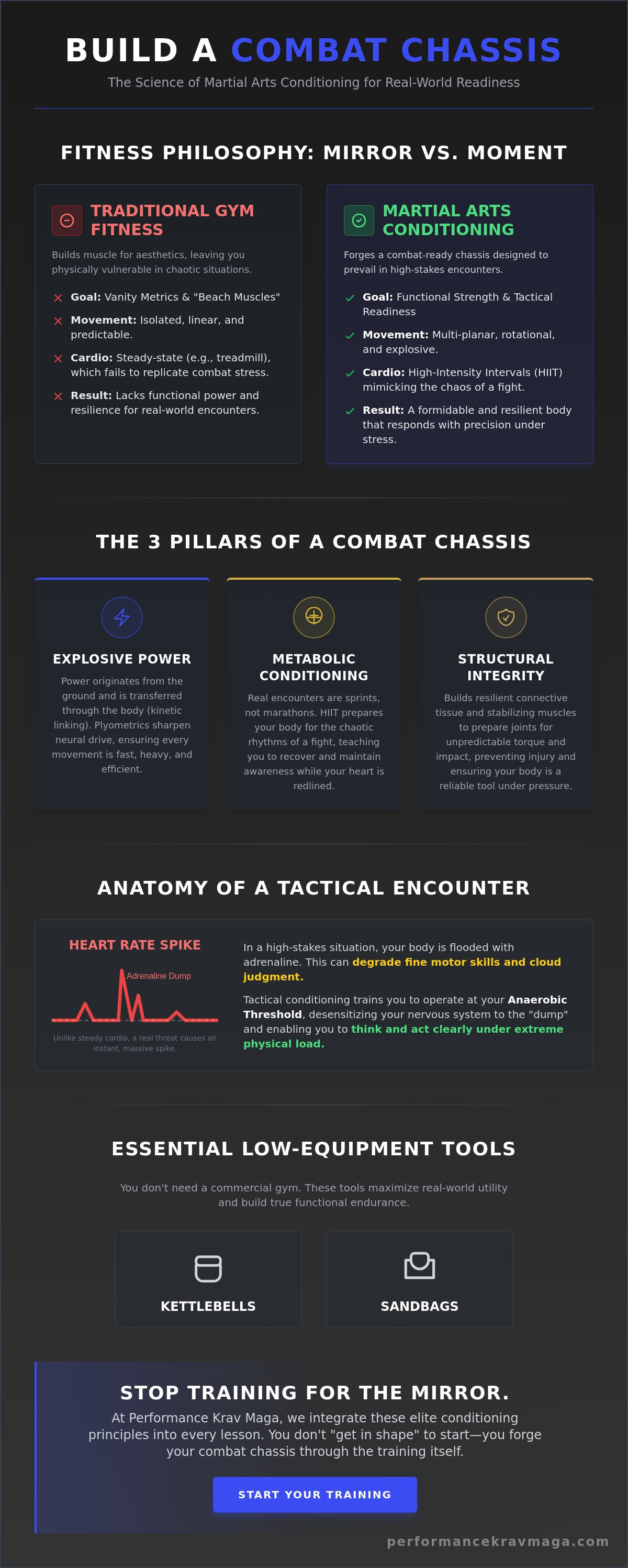
In a high-stakes self-defense situation, your heart rate doesn't climb steadily; it spikes instantly. This triggers a massive adrenaline dump that can degrade fine motor skills and cloud your judgment. Effective training focuses on your Anaerobic Threshold, teaching your body to operate at peak output without immediate collapse. Tactical conditioning is the ability to maintain cognitive function while under peak physical load. By training in this red zone, you desensitize the nervous system to the "dump," ensuring you can still strike, move, and think when your lungs are burning.
Why Gym Fitness ≠ Combat Readiness
Standard gym routines often prioritize "beach muscles" through isolated, linear movements. While a heavy bench press is impressive, it doesn't equate to the rotational power required to deliver a finishing strike in a combat sport or a street encounter. Fighting is multi-planar. It requires your core to act as a bridge between the ground and your limbs, transferring force through complex angles. You aren't just moving weight; you're moving yourself through space against a resisting force.
Beyond power, you must develop structural integrity. Linear machines don't prepare your joints for the unpredictable torque of a grapple or the impact of a block. Real martial arts conditioning builds resilient connective tissue and stabilizing muscles, which are essential for preventing training injuries and ensuring you can handle real-world stress without breaking. Efficiency is the goal. Every movement must have a purpose, and every muscle must contribute to the mission of staying safe and ending the threat.
The Three Pillars of Tactical Combat Fitness
Building a combat chassis requires a focus on three distinct yet interconnected pillars. You don't build these in isolated phases. You develop them simultaneously. Effective martial arts conditioning demands a body that can explode with violence, recover in seconds, and absorb impact without structural failure. Training considerations for high-stakes environments suggest that isolating these traits often leads to performance gaps when the pressure is highest. You need a unified system that prepares you for the unexpected.
Explosive Power and Kinetic Linking
Power starts at the ground. It travels from your feet, through the rotational torque of your hips, and finally into your hands or feet. This is kinetic linking. We use plyometrics to sharpen neural drive and reaction speed, ensuring your movement is lean and functional. There is no wasted motion. Every twitch is a calculated response designed to remove obstacles. By focusing on explosive power, you ensure that your first strike is as effective as your last. It's about being fast and heavy at the same time.
Metabolic Conditioning for the Real World
A real-world encounter is a high-intensity sprint. Traditional cardio won't save you here. We utilize High-Intensity Interval Training (HIIT) specifically tailored to the chaotic rhythms of a fight. You strike, move, and then immediately focus on recovery breathing. This isn't just about oxygen intake. It's about maintaining situational awareness while your heart rate is redlined. You learn to manage the "pulse" of the fight so you don't gas out when it matters most. For those ready to test their limits, Krav Maga classes provide the perfect environment to build this functional endurance.
Resilience and Injury Prevention
Hardening the body is the final piece of the tactical puzzle. Grip strength and neck stability are often overlooked, yet they are critical for effective self-defense. We prioritize stability over simple flexibility. Being "bendy" is less useful than being structurally sound when an aggressor is trying to move you against your will. This resilience ensures you stay in the fight. If you are wondering how long to learn Krav Maga, understand that your timeline is directly tied to how well you maintain this structural integrity. A resilient body allows for consistent training, faster proficiency, and a superior level of martial arts conditioning.
Tactical Readiness vs. Sport Performance: Choosing Your Methodology
The most common objection potential students raise is the belief that they need to "get in shape" before they start training. This is a tactical error. Martial arts conditioning in a reality-based system isn't a prerequisite; it's a byproduct of the work itself. You don't run miles on a treadmill to prepare for a fight. You execute the techniques under stress to forge the fitness required to sustain them. In Krav Maga, the conditioning is built through the strikes, the defenses, and the movement patterns. This ensures your physiological response is perfectly calibrated to the actual tools you'll use in a crisis.
There is a fundamental difference between training for a match and training for the street. An MMA fighter prepares for 3-5 minute rounds with a referee, a controlled floor, and a single opponent. Their conditioning is designed for a prolonged struggle. Your goal as a tactical practitioner is immediate resolution. You want to neutralize the threat and exit the area in seconds. This requires an explosive "pulse" of energy rather than the endurance to win a decision on points. It's about being formidable in the first ten seconds, not just the last ten minutes.
This methodology also develops the "Warrior Mindset." When your body is tired and your lungs are burning, your brain must remain aggressive and focused. We condition the mind to stay in the fight when the physical "gas tank" feels empty. It's a disciplined approach that prioritizes survival over sport, ensuring you have the psychological fortitude to maintain control when the environment turns chaotic.
The "Match" vs. The "Street"
The gym is a safe, controlled environment with mats and rules. The street is concrete, curbs, and multiple attackers. Sport-based conditioning often ignores the necessity of immediate de-escalation or escape. If you're investigating practical self defense classes in Atlantic County, you'll see that reality-based training focuses on environmental awareness. You don't just stay and fight; you use your conditioning to create an opening and get to safety. Every ounce of energy spent must serve the mission of going home alive.
Efficiency as a Survival Tool
Krav Maga favors simple, instinctive movements because they are the most efficient. Complex techniques fail when your heart rate hits 175 BPM and your fine motor skills evaporate. By mastering an economy of motion, you conserve vital energy for the moments that matter most. Martial arts conditioning allows you to execute these movements with precision even under extreme duress. There's a massive psychological boost in knowing your body won't quit before the threat is neutralized. You become a "Quiet Professional" who is ready, efficient, and capable of handling real-world stress without hesitation.
Building Your Combat Chassis: A Practical Training Framework
Forging a body that can withstand the rigors of combat doesn't require an elite powerlifting gym or complex machinery. It requires a commitment to utility. A practical framework for martial arts conditioning balances technical skill work with dedicated physical hardening. We focus on a "Performance Pulse" approach. This methodology alternates between high-intensity bursts that redline your heart rate and moments of technical precision that require total composure. By training this way, you ensure your "combat chassis" is ready to respond with efficiency when the environment turns hostile.
Your weekly schedule should prioritize movement over muscle isolation. We utilize bodyweight exercises, kettlebells, and sandbags because they mimic the unpredictable nature of a human opponent. Progressive overload is essential, but it must never come at the expense of technical form. If your stance breaks down because you're chasing a faster time, you're building a liability, not an asset. If you're ready to start building this foundation today, join our Krav Maga classes to experience this framework in action.
The Essential Movement Patterns
Every effective strike or defense is built on three fundamental patterns. The Squat and Lunge provide the foundation for your stance and your ability to move explosively through space. Push and Pull movements develop the upper body strength necessary for clinching and generating force. Finally, the Rotation is the "engine room" of all martial arts power. Without a strong, rotational core, your strikes lack the weight needed to end a threat quickly. We train these patterns to ensure your body operates as a single, unified weapon.
Sample Conditioning Circuits
To simulate the chaotic rhythm of a fight, we use a "Standard Tactical Circuit." This involves high-output movements like sprawls and strikes followed by short, 10-yard sprints. For absolute beginners, these movements are scaled to ensure you don't burn out before the skill work begins. You might start with fewer repetitions or longer rest periods to maintain structural integrity. Always prioritize the quality of the movement over the speed of the clock. Speed is a byproduct of efficiency, and efficiency is born from perfect practice.
Recovery and Longevity
Hardening the body is only half the battle; you must also allow it to rebuild. Our family-like community provides the accountability needed to stay consistent, but your progress depends on what you do outside the classroom. Sleep and nutrition are the raw materials that fuel your resilience. Without proper recovery, even the best martial arts conditioning program will lead to diminishing returns. For a deeper dive into specific drills that build elite fitness, explore The Krav Maga Workout and learn how to refine your tactical readiness.
Conditioning at Performance Krav Maga: Training for the Real World in Egg Harbor City
Performance Krav Maga serves as the national headquarters for the Krav Maga Federation of America (KMFA). Located in Egg Harbor City, this facility isn't just a place to sweat; it's where the science of survival meets physical transformation. Chief Instructor Greg Dziewonski ensures that martial arts conditioning is woven into the fabric of every lesson. You won't find yourself doing repetitive, mindless sets just to pass the time. Instead, you'll perform high-intensity drills that mirror the physiological demands of a real-world threat, ensuring your body and mind are calibrated for peak performance.
We maintain an "Elite but Humble" environment. It's a space where beginners are coached alongside experts without ego or intimidation. This culture reflects the "Quiet Professional" mindset. We prioritize efficiency and readiness over flashy displays. Whether you're a professional looking to sharpen your edge or a newcomer seeking to feel safe, our community supports your individual journey. It's a disciplined environment that respects tradition but focuses ruthlessly on what works in the modern world. You'll find a supportive, family-like atmosphere that challenges you to move from vulnerability to strength.
The Atlantic County Tactical Advantage
Our Egg Harbor City facility is the hub for authentic Israeli Krav Maga in the region. For South Jersey residents, this provides a formidable fitness boost that goes far beyond the capabilities of a standard commercial gym. You'll gain a psychological boost that comes from physical competence and high-level instruction. We remove the obstacles to your progress by providing a structured, logical path to safety. Training here means joining a lineage of practitioners dedicated to readiness, efficiency, and real-world application.
Your First Step Toward Mastery
The biggest hurdle is often the internal voice saying you aren't ready. Stop waiting. You don't need to be in peak condition to start our Krav Maga classes; you start training to reach that peak. The process is low-friction and designed to welcome the uninitiated into the fold. We guide you from curiosity to conviction through a layered approach that builds your skills and your martial arts conditioning simultaneously. Our instructors are equally comfortable in high-stakes environments and supportive classrooms. Take control of your safety. Join a community focused on real-world results and start your transition to formidable fitness today.
Forge Your Combat Chassis Today
True fitness isn't found in the mirror. It's forged in the classroom through disciplined action and purposeful movement. You now understand that martial arts conditioning is a specialized process that integrates explosive power with metabolic efficiency. By focusing on the three pillars of tactical fitness, you've learned how to build a body that doesn't just look strong but functions with instinctual precision under extreme stress. This path leads to a version of yourself that's ready, resilient, and capable of removing obstacles in the real world.
It's time to transition from vulnerability to formidable strength. At Performance Krav Maga, the national headquarters for the Krav Maga Federation (KMFA), we provide authentic Israeli Krav Maga tailored specifically for South Jersey residents. Under the guidance of Chief Instructor Greg Dziewonski, you'll train in an environment that values efficiency and real-world results. Start Your Transformation at Performance Krav Maga, Book Your First Class in Egg Harbor City Today! You have the roadmap. Now, take the first step toward your new baseline of competence.
Frequently Asked Questions
Do I need to be in shape before starting martial arts conditioning?
You don't need to be in peak physical condition to begin your journey. Martial arts conditioning is built through the training process itself, not before it starts. Beginners are coached to move at a pace that matches their current ability while steadily increasing intensity. This ensures you develop the necessary strength and stamina without unnecessary risk of burnout or injury. Your fitness is a byproduct of your commitment to the work.
How many days a week should I train for optimal martial arts fitness?
Consistency is more important than volume when you're starting out. Two to three sessions per week provide enough stimulus for your body to adapt while allowing for the recovery needed to harden your tissues. As your resilience grows, you can increase this to four or five days. Always prioritize the quality of your output over the quantity of hours spent on the mat. Recovery is where the actual growth happens.
Is martial arts conditioning better than lifting weights at a regular gym?
It isn't necessarily "better," but it is more functional for real-world safety. Traditional gym routines focus on linear, isolated movements that build muscle for appearance. In contrast, martial arts conditioning prioritizes multi-planar movement and rotational power. This develops a body that can generate force from any angle, which is a critical advantage in a tactical encounter. You're building a tool for performance rather than a display for the mirror.
Can I build muscle through martial arts conditioning alone?
You can absolutely build significant lean muscle mass through combat-based training. The explosive nature of strikes, sprawls, and resistance drills forces your muscles to adapt to high-tension loads. This creates a dense, functional physique that is optimized for movement rather than bulk. While you won't look like a bodybuilder, you'll develop the "combat chassis" required to handle extreme physical stress with efficiency and power.
What is the best type of cardio for a martial artist?
High-Intensity Interval Training (HIIT) is the most effective method for preparing for a fight. Real encounters don't happen at a steady, rhythmic pace; they occur in violent, unpredictable bursts. Sprints, heavy bag intervals, and calisthenic circuits mimic this "pulse" more accurately than long-distance running. This type of training improves your anaerobic threshold, allowing you to maintain cognitive function and physical output when your heart rate redlines.
How do I prevent injuries while doing high-intensity combat fitness?
Prioritize technical form over the speed of the clock or the number of repetitions. Most injuries occur when fatigue causes a breakdown in structural integrity. Listen to your body and scale movements when necessary to ensure you're training within your current limits. Incorporating mobility work and focusing on joint stability will also help harden your body against the impact and torque inherent in tactical training.
What equipment do I need to start conditioning at home?
You can achieve elite results with minimal equipment or even just your own bodyweight. Kettlebells and sandbags are excellent tools because they provide "dead weight" that shifts and challenges your stability, much like a human opponent. If you don't have access to these, focus on fundamental patterns like push-ups, squats, and lunges. The goal is to build utility and resilience, which doesn't require a room full of complex machines.
How long does it take to see results from a combat-based workout?
Most students begin to notice a significant shift in their energy levels and movement efficiency within four to six weeks of consistent training. This is the period where neural adaptations occur and your metabolic system becomes more efficient at handling high-intensity loads. Visible changes in body composition typically follow soon after. Stay focused on the process and the results will manifest as a natural consequence of your disciplined effort.


Comments