
How Long to Learn Krav Maga? Your Timeline to Real-World Proficiency
- Greg Dziewonski
- May 19
- 13 min read

Survival isn't a trophy you earn after twenty years; it's a skill you build in weeks. While traditional martial arts often focus on aesthetic forms and ritualistic progression, Krav Maga was engineered for the military to turn raw recruits into capable fighters in the shortest time possible. If you are wondering how long to learn Krav Maga, the answer depends on whether you want to be functional on the street or an elite practitioner. It's common to feel vulnerable in public spaces and fear that you'll never have the time to truly protect yourself. We understand that confusion over ranking systems and time-in-grade requirements can make the journey feel out of reach.
This guide provides a realistic timeline for mastering the system, from your first street-ready techniques to achieving advanced status. You'll discover how the first four months of training build a foundation of instinctive strikes and choke defenses that can change your life. We will map out the path from basic proficiency to the years of discipline required for a black belt, ensuring you have the confidence to handle common street scenarios. By the end of this article, you'll have a clear roadmap to transition from vulnerability to formidable strength through our specialized self-defense classes.
Key Takeaways
Understand how Krav Maga prioritizes immediate functionality, ensuring you gain a life-saving skill starting with your very first class.
Discover exactly how long to learn Krav Maga using a structured roadmap that transforms natural flinch responses into tactical counter-attacks within six months.
Learn why eliminating traditional katas and ritualized forms creates a significantly faster learning curve compared to sport-based martial arts.
Identify the ideal training frequency and consistency levels required to ensure long-term retention and prevent the loss of critical muscle memory.
See how professional instruction at a national headquarters provides the clear path needed to evolve from a beginner to an advanced practitioner.
Table of Contents
The Krav Maga Timeline: From First Class to Functional Proficiency
You don't have years to wait for safety. Traditional martial arts often focus on the journey of a lifetime, but Krav Maga was built for the soldier who needs to be lethal by Tuesday. It is a tactical system, not a sport. When people ask how long to learn Krav Maga, they are usually asking when they will stop feeling like a victim. The answer is immediate. In your very first class, you'll learn a life-saving response, such as a groin strike or a palm heel strike, that you can use tonight. We don't waste time on ritualized bows or complex katas. We focus on what works when the adrenaline is dumping into your system.
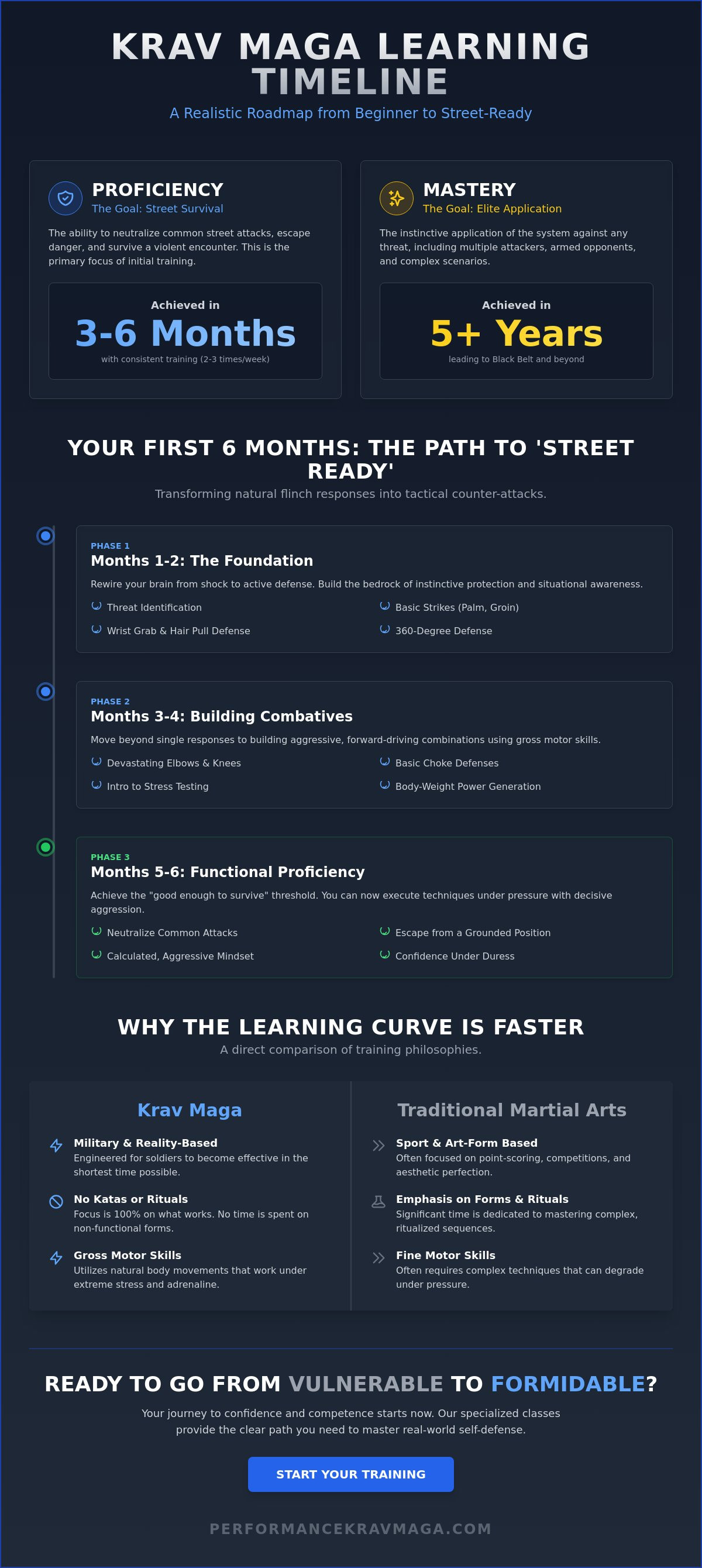
There is a massive gap between knowing a technique and executing it under pressure. You might understand how to throw a punch in a vacuum, but doing it while someone is grabbing your shirt and screaming in your face is a different reality. This is why our Krav Maga classes prioritize stress testing. We move you past the intellectual understanding of a move into the realm of instinctive muscle memory. When assessing how long to learn Krav Maga for basic self-protection, the 3 to 6 month window is the gold standard for dedicated students. Within this timeframe, most practitioners reach a level of functional proficiency where they can neutralize common street attacks with decisive aggression.
The Difference Between Proficiency and Mastery
Proficiency is about survival. It is the ability to clear a choke, strike a vulnerable target, and escape the danger zone safely. Mastery, however, is the instinctive application of the system against armed attackers or multiple threats. It is a pursuit that takes years of disciplined effort. We prioritize the "good enough to survive" threshold early because the street doesn't wait for you to earn a black belt. We want you dangerous in months, not decades. Our self-defense classes focus on the 80/20 rule: 80% of your safety comes from the 20% of techniques that are easiest to learn and hardest to stop.
Why Your First 10 Lessons Are the Most Critical
Your first ten sessions are about rewiring your brain. We build the foundation of situational awareness and a neutral, balanced stance. You will learn to transition from a frozen state of shock to an active defense. This is where the warrior mindset takes root. You stop thinking about what might happen and start preparing for what you will do. These early lessons establish the psychological boost that comes from physical competence. It is the most intense period of growth in your journey. You aren't just learning moves; you're adopting a new way of interacting with the world.
The 0-6 Month Roadmap: What It Means to Be 'Street Ready'
Street readiness isn't about mastering every possible technique; it's about owning the ones that save your life. When people ask how long to learn Krav Maga, they're often looking for a timeline to feel safe walking to their car at night. In our Level 1 curriculum, we strip away the fluff. We focus on gross motor skills because fine motor coordination evaporates the moment your heart rate hits 140 beats per minute. This initial six-month window transforms your natural flinch response into a tactical counter-attack, ensuring you don't just survive an encounter but end it decisively.
The core of this roadmap involves building a library of high-impact combatives. You will learn to deliver devastating punches, elbows, knees, and kicks that utilize your entire body weight for maximum force. Research into the effectiveness of self-defense training suggests that structured programs like these significantly increase a person's ability to prevent violence while boosting overall psychological resilience. By the end of this phase, you aren't just reacting; you're operating with a calculated, professional intensity.
Month 1-2: The Foundation of Defense
Your first sixty days focus on the "pre-fight" phase. You'll learn to identify threats before they bridge the gap into your personal space. Training covers basic strikes and immediate defenses against common grabs, such as wrist locks and hair pulls. The 360-degree defense serves as the bedrock of Level 1, providing a universal shield against circular attacks from any direction. These early self-defense classes establish the muscle memory needed to protect your vitals under sudden duress.
Month 3-6: Integrating Counter-Attacks
Once your foundation is solid, we introduce the concept of aggressive neutralization. You'll move from pure defense to simultaneous "defend and counter" movements. This period focuses on escaping chokes, headlocks, and bear hugs from the front, side, and rear. We utilize stress drills to simulate the adrenaline dump of a real-world attack, forcing you to execute techniques while exhausted or surprised. This is where you learn that the best defense is a relentless, overwhelming offense that creates the opportunity to escape safely.
Physical stamina is a non-negotiable part of the timeline. A real-world violent encounter is rarely a long, drawn-out affair; it's usually a high-intensity 30-second explosion of energy. Our training prepares your cardiovascular system to handle that peak output without gassing out. If you're ready to start your journey toward functional proficiency, joining a dedicated community is the most efficient way to stay consistent and see results.
Factors That Influence How Fast You Learn
The speed of your progression isn't just about the hours spent on the mat; it's about the quality of your focus. When calculating how long to learn Krav Maga, you must account for your own biological and psychological variables. We've seen students achieve street readiness in four months, while others take eight. The difference usually comes down to consistency and intent. If you treat your sessions like a casual workout, your progress will stall. If you train with the urgency of a real-world encounter, your body adapts at an accelerated rate.
Training frequency is the most significant lever you can pull. Attending 2 to 3 sessions per week is the "sweet spot" for long-term retention. This rhythm allows your central nervous system to recover while keeping the neural pathways for tactical movements fresh. If you skip two weeks, your muscle memory begins to degrade. You aren't just missing new information; you're losing the instinctive edge you've already built. Consistency is the glue that turns a learned move into an unbreakable habit.
Intensity: You must eventually train at the speed of life. Slow drills build mechanics, but you need high-stress simulations to ensure the technique works when the adrenaline hits.
Previous Experience: A background in Muay Thai or BJJ provides a head start on body mechanics. However, sport-based habits, like looking for a referee or fighting for points, must be unlearned to prioritize immediate neutralization.
Intent: Every strike in our Krav Maga classes is delivered with the intent to end the threat. Training with this "warrior mindset" shortens the learning curve significantly.
Frequency vs. Retention: The Science of Muscle Memory
The brain hardwires tactical movements through a process called myelination. Every repetition of a 360-defense or a counter-strike strengthens the neural pathway. We utilize the "Law of Primacy," which states that the first thing you learn is what you'll revert to under stress. This is why we insist on perfect form from day one. Be careful of overtraining, though. If you push too hard without rest, your tactical decision-making slows down, and your risk of injury increases. Balance is essential for elite performance.
Mental Conditioning and Situational Awareness
Your training doesn't end when you leave the gym. You can practice situational awareness during your daily commute in Egg Harbor City by scanning for exits and identifying "pre-attack cues" in the environment. Visualization is another powerful tool; mentally rehearsing your response to a specific threat can improve your physical performance by up to 20%. Learning to "switch on" the warrior mindset outside of class ensures that you are never caught off guard. This mental readiness is a core component of our self-defense classes.
Krav Maga vs. Traditional Martial Arts: Why the Curve is Faster
Traditional martial arts often demand years of dedication before their techniques become applicable in a chaotic street fight. When exploring how long to learn Krav Maga, the comparison reveals a stark contrast in pedagogical efficiency. Krav Maga is not an "art" in the classical sense. It is a tactical system that has systematically eliminated katas and ritualized forms. We don't spend time on aesthetic perfection or historical preservation. We focus on the most direct path to survival. A student in our martial arts classes can reach a level of street utility in six months that might take a Karate practitioner three years to achieve.
Training for a ring is fundamentally different from training for an alley. In a sport, you have a referee, a weight class, and a set of rules designed to keep both participants safe. On the street, there are no weight classes, and your attacker likely has a weapon or a friend nearby. Our Krav Maga classes strip away the sport-based habits that can lead to hesitation in a real encounter. We don't train for points or trophies. We train to end the threat decisively and get home safely. This tactical focus allows us to bypass the years of fluff found in traditional systems.
Gross Motor Skills vs. Fine Motor Skills
Under high-stress adrenaline dumps, your body undergoes a physiological shift. Fine motor skills, such as complex joint locks or intricate finger movements, frequently fail. You lose the ability to perform precise actions when your heart rate spikes. Krav Maga solves this by utilizing gross motor skills. These are large, natural movements that rely on your body's instinctive flinch response. This follows the "Keep It Simple, Stupid" (KISS) principle of Israeli defense. By working with your biology rather than against it, we slash the time required to build effective muscle memory.
Training for the 'Worst Day' Scenario
Sport-based arts often build a dangerous habit: staying in the pocket to trade blows. In a real-world scenario, your goal is to neutralize and escape. This requires a specialized curriculum that includes weapons defense and managing multiple attackers from the very beginning. At Performance Krav Maga, we maintain these high tactical standards by ensuring every drill simulates a "worst-case" environment. We prepare you for the chaotic reality of the modern world, not the controlled environment of a competition mat. If you are ready to stop practicing for a trophy and start training for your life, join our Krav Maga classes and experience the difference of a results-driven system.
Mastering the System at Performance Krav Maga
Training at the KMFA National Headquarters in Egg Harbor City provides a direct line to the source of the system. This facility isn't just another gym; it's the tactical hub for the Krav Maga Federation of America. Under the disciplined mentorship of Chief Instructor Greg Dziewonski, students undergo a calculated transformation from vulnerability to formidable strength. The atmosphere strikes a balance between being intensely motivational and professionally serious. You'll join a family-like community where every student is invested in your progress. We don't just teach moves. We build the "Performance" difference by combining high-energy fitness with high-stakes tactical training. Validate your skills. Own your safety.
Structured level testing is the cornerstone of our methodology. We don't hand out ranks based on attendance or time served. We pressure-test your skills to ensure you can execute them when it matters most. This validation process is vital when you consider how long to learn Krav Maga, as it provides a clear, objective measure of your proficiency. You'll always know exactly where you stand on the roadmap to mastery. This logical progression keeps you moving forward without hitting the frustrating plateaus common in other martial arts classes. You'll gain the psychological boost that comes from genuine physical competence.
The KMFA Curriculum Advantage
Our curriculum is rooted in authentic Israeli Krav Maga but has been meticulously adapted for modern American threats. We focus on the reality of the streets today, not the battlefields of the past. The tiered progression moves you through foundational combatives to advanced weapons defense in a way that feels seamless and efficient. Beyond our regular Krav Maga classes, students gain access to advanced seminars and specialized tactical workshops. These sessions provide deep dives into complex scenarios, ensuring your readiness is comprehensive and current. We prioritize what works in the real world.
Your Path Starts in Atlantic County
Taking the first step is often the most difficult part of the journey. Your experience begins with a specialized Induction class at our facility. We've designed this session to be accessible yet challenging, allowing us to meet you at your current fitness level while showing you the path ahead. We support every student's individual journey, whether you're looking for elite-level conditioning or simply want to feel safer on your walk home. Our instructors are experts at bridging the gap between where you are and where you need to be. It's time to trade fear for readiness.
Secure Your Future with Tactical Readiness
Time is a luxury you don't have when your safety is on the line. The journey from your first class to a state of functional proficiency is measured in months, not years. By prioritizing gross motor skills and instinctive responses, you bridge the gap between vulnerability and strength faster than in any traditional sport-based system. When you consider how long to learn Krav Maga, remember that the system was built for speed and efficiency.
Real-world proficiency requires a disciplined environment and elite mentorship. At Performance Krav Maga, the National Headquarters of the KMFA, we've spent years serving Egg Harbor City and South Jersey with high-energy training that works. Led by Chief Instructor Greg Dziewonski, our classes ensure you aren't just learning moves but adopting a warrior mindset. You've seen the roadmap; now it's time to take the first step on the path.
You have the power to change your story. Start building the confidence to handle any scenario and walk with the quiet professional pride of a trained practitioner.
Frequently Asked Questions
How long does it take to get a black belt in Krav Maga?
Achieving a black belt typically requires 4 to 8 years of consistent, dedicated training. This timeline accounts for the progression through Practitioner and Graduate levels before being invited to test for an Expert rank. It's a journey of mastery that demands physical competence and psychological resilience. While you become "street ready" early on, the black belt signifies a deep, technical understanding of the entire system against complex threats.
Can I learn Krav Maga if I'm not in good shape?
You don't need to be in peak physical condition to begin your first class. Krav Maga is designed to use your body's natural mechanics, making it accessible to everyone regardless of their current fitness level. Our self-defense classes will improve your stamina and strength as you progress. We focus on efficiency and instinct, ensuring that your ability to neutralize a threat isn't dependent on being an elite athlete.
Is 6 months enough time to actually defend myself?
Six months is a sufficient window to develop a functional base for real-world self-defense. During this time, you will master the fundamentals of striking and defenses against common chokes or grabs. While you won't be a master, you will have the warrior mindset and muscle memory needed to react under pressure. This timeframe is often the tipping point where a student transitions from vulnerability to genuine tactical readiness.
How many times a week should a beginner train Krav Maga?
A beginner should aim to train 2 to 3 times per week to ensure optimal retention and physical adaptation. This frequency allows your body to recover while keeping the neural pathways for tactical movements fresh. If you are wondering how long to learn Krav Maga basics, this "sweet spot" ensures you reach functional proficiency within approximately four months. Consistency is more important than intensity in the early stages.
What is the difference between Practitioner and Graduate levels?
Practitioner levels focus on civilian self-defense scenarios and fundamental combatives. Graduate levels introduce more complex tactical situations, including third-party protection and advanced weapons defense. While Practitioner levels build the foundation of safety, the Graduate ranks transition the student into a more professional, well-rounded fighter. Each level is validated through rigorous testing to ensure your skills remain sharp and reliable under stress.
Can I learn Krav Maga at home using online videos?
You cannot effectively learn Krav Maga solely through online videos because the system requires live stress testing and partner feedback. While videos can supplement your knowledge, they cannot simulate the adrenaline dump or the physical resistance of a real attacker. True proficiency comes from training in a controlled environment with qualified instructors who can correct your form and push your limits safely. Real-world skills require real-world practice.
How long does a typical Krav Maga class last at Performance Krav Maga?
A typical class at Performance Krav Maga lasts approximately 60 minutes. Each session is structured to maximize efficiency, beginning with a high-energy warm-up followed by technical instruction and ending with high-stress drills. This timeframe ensures you get a full-body workout while building the specific muscle memory needed for self-defense. We respect your time by keeping the instruction lean, functional, and results-oriented from start to finish.
Does Krav Maga take longer to learn for women than for men?
There is no difference in how long to learn Krav Maga for women compared to men. The system is based on instinctive movements and gross motor skills that don't rely on raw size or strength. Because Krav Maga targets an attacker's vulnerabilities, anyone can become proficient in the same timeframe. Our martial arts classes empower all students to neutralize threats quickly, focusing on leverage and aggressive counter-attacks rather than physical bulk.


Comments