
Multiple Attacker Defense: Tactical Strategies for Real-World Survival

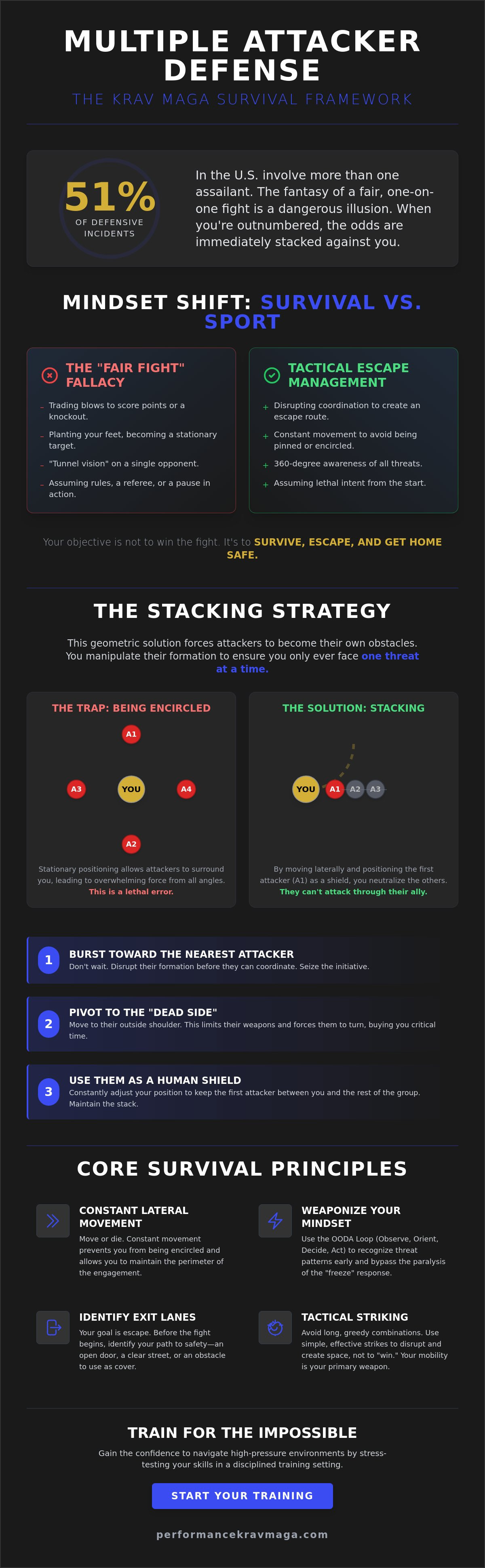
Did you know that over 51% of defensive incidents in the United States involve more than one assailant? This statistic highlights a brutal truth that shatters the common fantasy of a fair, one-on-one fight. When you're targeted by a group, the odds are immediately stacked against you. It's natural to feel overwhelmed by the sudden chaos of a multiple attacker defense scenario. You might fear freezing as the group begins to encircle you, or feel a frantic confusion about which threat to prioritize first.
We understand that the transition from vulnerability to strength starts with a clear, tactical framework. You don't need to be the strongest person in the room to survive; you just need to be the most efficient. This guide will help you master the essential Krav Maga principles and tactical positioning required to escape when you're outnumbered. We will explore the geometry of movement, the psychological shift needed to act decisively under pressure, and the critical difference between fighting for sport and fighting for your life.
Key Takeaways
Redefine your objective by prioritizing tactical escape management over the "fair fight" fallacy found in traditional combat sports.
Apply the "Stacking" principle to transform your enemies into human shields, effectively neutralizing their numerical advantage through multiple attacker defense.
Master the art of constant lateral movement to maintain the perimeter and avoid the lethal trap of being encircled or pinned.
Weaponize your mindset using the OODA Loop to recognize threat patterns early and bypass the paralysis of the "freeze" response.
Gain the confidence to navigate high-pressure environments by understanding how to stress-test your skills in a disciplined training setting.
Table of Contents
The Reality of Multiple Attacker Defense: Survival vs. Fighting
Forget the cinematic illusions of a lone hero effortlessly dismantling a dozen adversaries. Real-world multiple attacker defense is a high-stakes security problem that requires tactical escape management rather than traditional combat. If you approach this like a boxing match, you've already lost. In a sports environment, you have rules, a referee, and a single opponent. On the street, you face a 360-degree threat environment where danger can strike from any angle. You must assume lethal intent from the start. When you're outnumbered, every second you spend "fighting" is a second you aren't moving toward safety.
The "Fair Fight" fallacy is a psychological trap that gets people hurt. You might wait for an opening or expect a pause in the action. Groups don't wait. They rely on overwhelming force and simultaneous strikes to shut down your ability to respond. Your priority isn't to trade blows or prove your toughness. It's to disrupt their coordination and create an opening for your escape. You are managing a crisis, not participating in a duel. Every movement must be calculated to keep you from being pinned down.
Why Traditional Sparring Doesn't Prepare You
Traditional martial arts often instill a dangerous "tunnel vision." You learn to lock onto the person in front of you, ignoring the peripheral movement of others. This creates a ring-based habit that leads to being encircled. In a gym, you might trade blows to land a point or a knockout. In a real encounter, landing a single strike is secondary to maintaining your mobility. If you plant your feet to throw a heavy punch, you're a stationary target for the second or third attacker. Efficiency matters more than ego. You need to move constantly, ensuring that no one can get behind you or pin you against a wall. Survival in a multiple attacker defense situation depends on your ability to break contact, not stay in the pocket.
The Goal: Creating a Path to Safety
Success isn't measured by who is left standing. It's measured by you getting home safe. This requires a mindset shift where you view the environment through a Defence in Depth Strategy. By using space and time as tactical barriers, you wear down the numerical advantage of your aggressors. You need immediate, explosive action to disrupt their plan and force a gap in their line. Identify your exit lanes before the physical confrontation even begins. Look for the open door, the clear street, or the obstacle you can put between yourself and the group. Your objective is simple: survive, escape, and live to see another day.
The Stacking Strategy: How to Defend Against Multiple Attackers
Move or die. It's that simple. In a crowd, the moment you stop moving is the moment you are overrun. Effective multiple attacker defense relies on a geometric solution called "stacking." This isn't about out-muscling three people at once. It's about forcing them to wait their turn. You want to align your attackers so they become their own worst obstacles, effectively tripping over one another while you maintain the perimeter of the engagement. By controlling the "Line of Force," you ensure that you only ever deal with one person at a time, regardless of how many are actually present.
Within the first three seconds of an encounter, you must identify the "Lead Attacker" and the "Flankers." The lead is usually the most aggressive or the one closest to your personal space. The flankers are the ones attempting to circle to your rear. By understanding these tactics for fighting multiple assailants, you can manipulate the group's formation. You don't just react; you dictate the flow of the encounter by positioning the lead attacker as a physical barrier between you and the rest of the group.
Step-by-Step: The Lining Up Maneuver
Step 1: Burst toward the nearest attacker. Don't wait for them to close the distance. Disrupt their formation before they can set their feet or coordinate a strike.
Step 2: Pivot to the "dead side." This is the outside shoulder of your opponent. By moving here, you limit their ability to use their secondary weapons and force them to turn, which takes time.
Step 3: Use them as a shield. Keep that first opponent between you and the remaining threats. If they move to flank you, you must move to keep the "stack" intact.
Tactical Striking and Redirection
Don't get greedy with combinations. Long, complex sequences keep you stationary for too long and invite the other attackers to close in. Use short, sharp strikes to facilitate movement. A palm heel to the face or a quick knee to the groin creates the space needed to transition to your next position. The "push-pull" mechanic is your best friend here. If an attacker lunges, use their momentum. Shove them directly into their partner. This creates a physical tangle that buys you precious seconds to escape.
While you work, you must manage your eye contact. Don't stare at the person you're hitting. Scan the environment to look for the next threat or an available exit lane. Developing these instincts takes consistent repetition in a disciplined environment. If you want to see how these movement patterns work in real-time, consider joining our Krav Maga classes to build the muscle memory required for survival.
Real-World Examples: 3 Scenarios of Outnumbered Defense
Theory vanishes when the circle closes in. To survive, you must translate abstract principles into immediate, reflexive action. Real-world multiple attacker defense isn't a choreographed dance; it's a chaotic scramble for the exit. By analyzing common high-pressure scenarios, we can identify the specific movement patterns that keep you mobile and conscious. Whether you are caught in an open street or pinned against a brick wall, your success depends on your ability to process the environment faster than your aggressors can coordinate their assault.
Scenario 1: Breaking the Circle
Imagine you're walking toward your car when three individuals begin to close the distance. Two approach from the front in a "V" formation, while a third lingers behind to cut off your retreat. This is the Encirclement. If you stay in the center of that "V," you're in the kill zone. You must use the "Burst and Pivot" technique immediately. Explode toward one of the flankers to disrupt their timing and force the group to reset. Your goal is to reach the "dead zone" as quickly as possible. The "dead zone" is the tactical space directly behind the lead attacker where the other assailants cannot easily reach you without moving through their own partner. By reaching this spot, you've turned a three-on-one into a series of one-on-one engagements.
Scenario 2: The Wall and the Exit
Being backed into a corner or against a building feels like a death sentence, but it offers one tactical advantage. A wall can serve as a "third hand" that secures your six o'clock, ensuring no one can get behind you. However, you cannot stay there. Static defense is a losing game. You must use aggressive clearing to create a path out. This involves a high-impact strike, such as a focused palm heel or a driving knee, to stun the nearest threat. This strike isn't meant to end the fight; it's meant to create a 2-second window for flight. This focus on rapid transition is why modern martial arts prioritizes mobility over the "stand and trade" mentality of the ring.
Scenario 3: The Protector
The stakes escalate when you aren't alone. If you're with a loved one, your multiple attacker defense strategy must shift from personal escape to "protect and move." You are the shield. You must position yourself between the threats and the person you're protecting while giving clear, verbal directives for them to run toward a specific exit. Use short, violent redirections to keep attackers at bay while you back away toward safety. You don't have the luxury of a long engagement. Every strike you deliver must be a catalyst for movement, ensuring that both you and your companion break the contact line before the group can fully commit to their attack.
The Warrior Mindset: Managing the Chaos of Multiple Threats
Physical proficiency is only half the battle. If your mind locks up under pressure, your technical skills remain trapped in the gym. Effective multiple attacker defense requires you to weaponize your psychology through the OODA Loop: Observe, Orient, Decide, and Act. You must process information faster than the group can coordinate. While they are still deciding who strikes first, you must have already oriented yourself to the nearest exit and decided on your first explosive movement. This mental speed is the core of warrior mindset training, turning a chaotic disadvantage into a structured tactical problem.
Overcoming the "freeze" response is a matter of pattern recognition. The brain freezes when it encounters a problem it hasn't cataloged. By training for multiple threats, you teach your mind to see a group not as an insurmountable obstacle, but as a single, multi-limbed entity. If one "limb" moves to flank you, the "body" of the group is shifting. You don't fight three individuals; you fight one system. This "One-Target" focus simplifies your decision-making process, allowing you to act with the decisive speed necessary for survival. You aren't just reacting to punches. You're disrupting a collective plan.
Situational Awareness as the First Line of Defense
The fight starts long before the first strike. You must learn to spot "Pre-Attack Indicators" before the circle closes. Watch for whispering, subtle flanking maneuvers, or individuals closing distance while checking their surroundings. Develop the "Exit Search" habit. Every time you enter a building or a confined space, identify at least two ways out. If a situation begins to escalate, use verbal de-escalation to create space. Your voice is a tactical tool. Use it to project confidence and set boundaries, potentially disrupting the "wolf pack" mentality before it turns into a physical assault.
Aggression as a Survival Tool
When de-escalation fails, you must flip "The Switch." This is the instant transition from calm awareness to explosive, controlled violence. Controlled aggression isn't blind panic; it's a calculated application of force designed to overwhelm the attackers' senses. Most predators expect a submissive victim. When you fight back with unexpected ferocity, you shatter their psychological momentum. This shock creates the 2-second window you need to execute your escape. Building this level of mental resilience is a cornerstone of our curriculum. If you're ready to develop this decisive edge, join our self-defense classes today.
Train for the Impossible at Performance Krav Maga
You've studied the theory. You understand the stacking principle and the psychological mechanics of the OODA Loop. But when the adrenal dump hits, your body won't remember what you read; it will only remember what you've repeated. In Egg Harbor City, we make multiple attacker defense drills a cornerstone of our curriculum because survival isn't an accident. It's the result of rigorous, stress-tested preparation. Our Krav Maga classes are designed to bridge the gap between knowing what to do and having the physical competence to execute it under fire. We push you to find your limits in the gym so you don't find them on the street.
Physical conditioning is the silent partner of tactical skill. High-speed defense requires explosive power and the lateral agility to stay outside the "V" formation. Our training sessions build the functional strength necessary to maintain your mobility when fatigue begins to set in. We don't just focus on the mechanics of a strike. We focus on the continuity of movement. You learn to transition from a redirection to an escape without losing momentum. This level of readiness is what separates a martial artist from a tactical defender.
What to Expect in a Multiple Attacker Drill
We utilize progressive resistance to build your confidence without compromising your safety. You won't be thrown into the fire on day one. We start with slow-motion "stacking" maneuvers to help you internalize the geometry of movement and threat prioritization. Once your mechanics are sound, we increase the intensity. This leads to the "Shark Tank" drill. In this scenario, you are placed in the center of a rotating group of attackers, forcing you to maintain mental clarity and endurance as the pressure mounts. Throughout this process, you receive direct feedback from Greg Dziewonski and our KMFA certified staff. This ensures every movement you make is efficient, utilitarian, and grounded in proven methodology.
Join the Performance Community in South Jersey
Training at Performance Krav Maga isn't about ego or intimidation. We've built a family-like atmosphere where every student is supported in their individual journey from vulnerability to strength. Egg Harbor City residents choose us because we provide a safe, disciplined environment to face uncomfortable realities. We don't just teach you how to hit; we teach you how to survive. You'll find a community of like-minded individuals who prioritize readiness and physical competence. It's time to move beyond the screen. Tactical competence is earned on the mat through sweat and repetition. Start your journey toward becoming formidable today.
Secure Your Perimeter: From Knowledge to Tactical Readiness
Mastering the geometry of multiple attacker defense is the difference between being a victim and a tactical survivor. You now understand that survival depends on constant lateral movement, the ability to stack your opponents, and a mindset that prioritizes escape over ego. These principles aren't just theories. They are life-saving habits that must be forged through repetition and stress-testing in a controlled environment. Real-world safety isn't a gift; it's a skill you develop through discipline and professional guidance.
As the National Headquarters for the Krav Maga Federation (KMFA), we provide an elite training ground for individuals of all fitness levels. Under the guidance of Chief Instructor Greg Dziewonski, you'll receive practical, reality-based instruction that strips away the fluff and focuses on what actually works. It's time to transition from awareness to action. Claim your introductory Krav Maga lesson in Egg Harbor City and start building the physical competence required to protect yourself and those who depend on you. We're ready to help you become the most formidable version of yourself.
Frequently Asked Questions
Is it really possible to defend against three or more people?
Yes, but you must redefine your objective as tactical escape rather than winning a traditional fight. You manage these high-stakes threats by using geometry and positioning to ensure you only engage one person at a time. It isn't about out-muscling a group. It's about using the stacking principle to create a temporary window of opportunity to exit the situation safely and efficiently.
What is the first thing I should do if I am surrounded?
Break the circle immediately by bursting toward the outside of the group. Don't wait for the attackers to set their feet or coordinate their strikes. Moving to the "dead side" of the nearest assailant prevents the others from reaching you easily. This proactive movement disrupts their "V" formation and allows you to begin the stacking process before they can fully enclose your position.
Should I try to fight the biggest person first?
No, you should prioritize the "Lead Attacker," who is the person closest to you or the one most likely to strike first. Size is secondary to immediate threat level and tactical positioning. Your focus is on disrupting the group's momentum to create a path for flight. Fixating on the largest person can lead to tunnel vision, allowing the flankers to move into your blind spots.
How do I avoid getting hit from behind during the fight?
Constant lateral movement and tactical scanning are your primary defenses against rear attacks. Never stand still or fixate on one opponent for more than a split second. By staying on the move and practicing disciplined eye contact management, you keep the other attackers in your field of vision. This ensures that they are either blocked by their own partners or kept at a manageable distance.
Can Krav Maga help me if the attackers have weapons?
Krav Maga is specifically designed to address armed threats, including knives, sticks, and firearms. In a multiple attacker defense scenario involving weapons, the stakes are significantly higher. This requires an immediate, aggressive redirection of the weapon followed by a rapid escape. Training focuses on developing instinctive, explosive responses to these life-threatening variables, ensuring you prioritize weapon control while maintaining awareness of the other threats.
What happens if I get taken to the ground by one of the attackers?
You must get back to your feet instantly using a tactical get-up. Being on the ground against multiple opponents is extremely dangerous because it leaves you vulnerable to kicks and stomps from the standing assailants. Use explosive movements to create space and regain your footing. Your goal is to re-establish your perimeter as quickly as possible to avoid being pinned down and overwhelmed by the group's collective weight.
How often should I train to be effective in these scenarios?
Consistency is key to building the muscle memory required for high-pressure multiple attacker defense. Training two to three times per week allows your body to internalize these complex movement patterns and reactive instincts. Regular attendance in our specialized drills ensures your responses remain sharp and your physical conditioning stays at a tactical level. This steady pace helps you transition from basic awareness to instinctive, decisive competence.
Are these techniques safe for beginners to learn?
Yes, we teach these skills using a progressive resistance model that prioritizes student safety. Beginners start with slow-motion drills to master the basic mechanics of stacking and movement before moving on to higher-intensity scenarios. Our ego-free, family-like environment ensures that everyone can develop these life-saving skills at their own pace. You'll build confidence through disciplined repetition without being subjected to unnecessary risk or aggressive sparring early in your journey.


Comments